

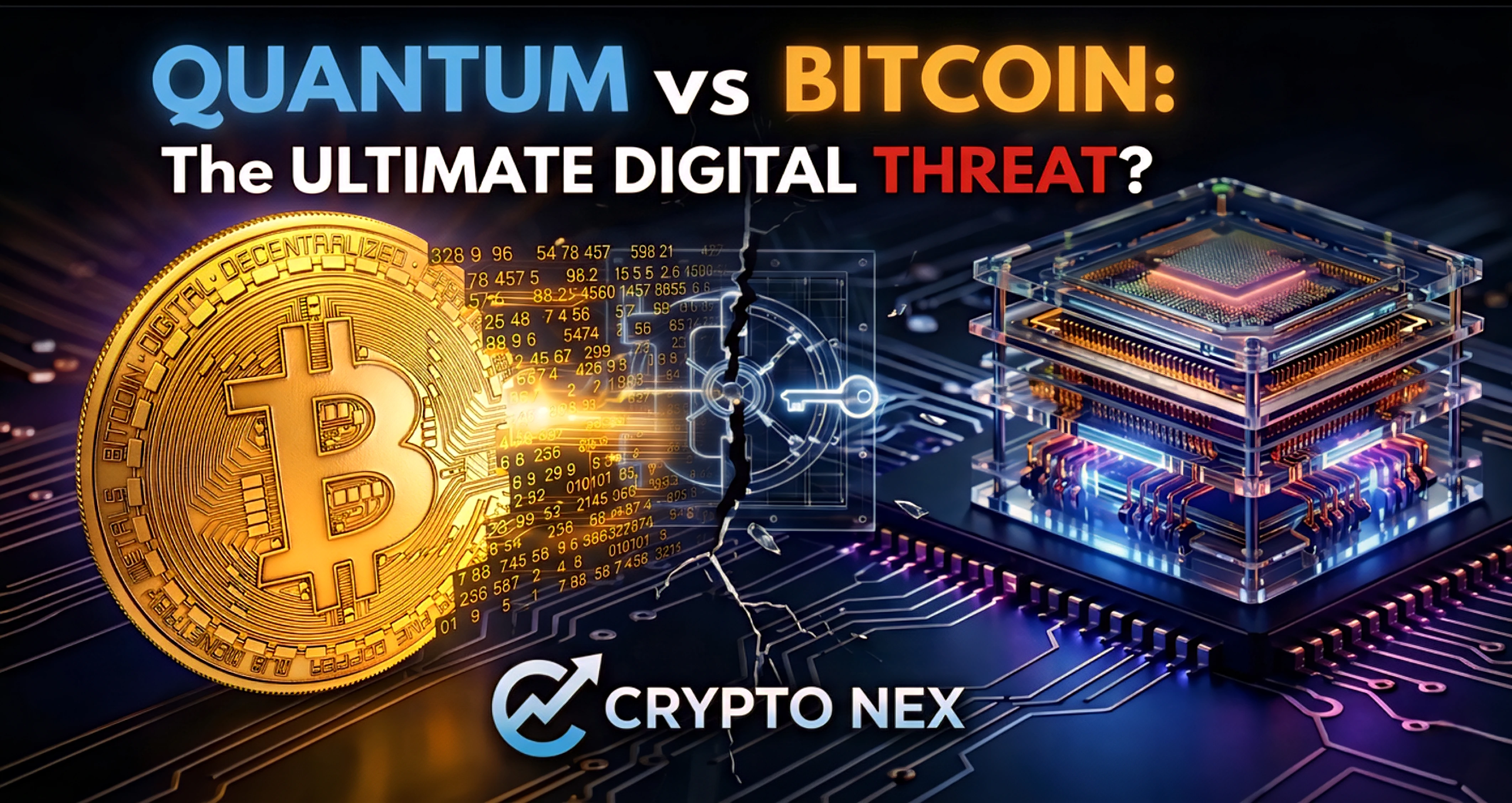
Can Quantum Computers Break Bitcoin?
Imagine locking coins in a vault today, then learning that a future machine might understand the lock better than anyone alive. That is the fear behind Bitcoin and quantum computers. The question is not whether quantum computers are magical Bitcoin killers. They are not. The real question is more specific: could a powerful enough quantum computer break the cryptographic keys that protect some Bitcoin, and what would the network do before that happens?
Bitcoin does not store coins like files in an account. It tracks who is allowed to spend each piece of Bitcoin. That permission is proven with cryptography. You do not show a password to the network. You show a digital signature that proves you control a private key. A private key is like a secret number so large that guessing it is hopeless. From that secret, your wallet can create a public key. The public key can be shared. The private key must stay hidden.
With normal computers, going from private key to public key is easy, but going backward is designed to be practically impossible. This is the core idea behind public key cryptography. One direction is fast. The reverse direction is hard. Bitcoin relies on this one-way street every time someone spends coins. The signature says, “I know the secret key,” without revealing the secret key itself.
Why quantum computers matter
Quantum computers do not solve problems the same way normal computers do. For some mathematical problems, the right quantum algorithm can find shortcuts that ordinary machines cannot use. That is why people take the topic seriously. A common mistake is thinking quantum computers make every hard problem easy. They do not. They are powerful for certain categories of math.
Bitcoin uses more than one kind of cryptography, and quantum computers affect those pieces differently. The main concern is Bitcoin's digital signature system. Bitcoin commonly uses elliptic curve cryptography for signatures. A sufficiently powerful, error-corrected quantum computer running the right algorithm could, in principle, derive a private key from an exposed public key. The word exposed is important.
In many common Bitcoin payment types, your public key is not fully visible on the blockchain until you spend from that address. Before spending, the chain often shows a hash of the public key, not the public key itself. That means the most dangerous risk is not every coin at once, but coins tied to addresses whose public keys are already visible or become visible when a transaction is broadcast.
Hashing versus signatures
Now let’s go one layer deeper, because the difference between a hash and a public key is where much of the quantum confusion begins. A hash is like a fingerprint of data. Bitcoin uses hash functions in several places, including addresses and mining. Quantum computers can speed up some search attacks against hashes, but they do not simply reverse hashes like opening a folder.
Two quantum ideas often get mixed together. Shor's algorithm is the scary one for public key systems like elliptic curve signatures. Grover's algorithm gives a more limited speedup for brute force search. That matters, but it is a different level of threat. Some people hear quantum and think Bitcoin mining instantly collapses. Mining is based on repeated hashing. A quantum advantage there is not the same as stealing private keys.
The clearest fear is not that every coin vanishes at once. The fear is that coins with exposed public keys become vulnerable. If a future quantum computer could calculate the matching private key fast enough, an attacker could create a valid spending transaction. There is also a more subtle scenario: when you spend Bitcoin, your public key may become visible before the transaction is confirmed. In a dangerous quantum future, an attacker might try to derive your private key during that window and broadcast a competing transaction.
Which coins are most exposed
Some Bitcoin outputs are more exposed than others. Older payment types and reused addresses can reveal public keys on chain. Once a public key is visible forever, a future attacker would not need to wait for a new spend. They could study that target at any time. This is one reason wallets generally encourage fresh addresses.
Address reuse is already bad for privacy. In a quantum risk discussion, it also increases how much public key information sits openly on the blockchain. Practical details matter here more than dramatic headlines. The threat is real in principle, but it depends on capability, timing, and whether the target public key has already been exposed.
What Bitcoin can do
Bitcoin is software, a network, and a community protocol. If the cryptography becomes unsafe, the path is not to give up. The path is to upgrade the rules so coins can be protected by quantum-resistant signature systems. Post-quantum cryptography means cryptography designed to resist known attacks from both classical and quantum computers.
For Bitcoin, the most relevant idea would be replacing or supplementing today's signature method with a post-quantum signature scheme. Changing Bitcoin's signature system is not like updating one app on your phone. Bitcoin nodes, wallets, exchanges, hardware devices, and users would all need a clear migration path. The network would need broad agreement on the rules and careful testing.
Some changes can be introduced in a backward-compatible way, while others require a deeper rule change. The exact path depends on the chosen design. The important point is that cryptographic migration is possible, but it is slow, political, and technical at the same time. If Bitcoin adopted quantum-resistant addresses, users would likely need to move coins into the new type of protection.
The hard policy question
That sounds simple, but at Bitcoin scale it becomes a coordination challenge. Some people may be inactive, some keys may be lost, and some old coins may never move. Lost coins create a difficult debate. If old exposed coins become vulnerable, should the network let anyone move them with a quantum-derived key, or should there be a deadline after which unsafe outputs are restricted?
Different people will have very different opinions. This is where the issue becomes philosophical. Bitcoin values property rights and predictable rules. But it also values security. Any proposal that freezes, migrates, or limits old coins would need to balance protecting the network with avoiding unfair control over other people's money.
The best mindset is urgency without panic. A practical attack on Bitcoin keys would require a quantum computer far beyond a simple demonstration. But waiting until the threat is already practical would be irresponsible, because Bitcoin upgrades take time. Avoid two extreme claims: first, that quantum computers will destroy Bitcoin tomorrow; second, that quantum computers do not matter at all.
What users should do
For ordinary users, the practical lesson is simple. Use well-maintained wallets. Avoid address reuse when possible. Keep your seed phrase safe. Pay attention to serious Bitcoin upgrade discussions, but do not make decisions based on viral fear posts.
Developers and researchers watch different questions. Which post-quantum signatures are secure enough? How large are the signatures? How expensive are they to verify? How can wallets migrate safely? The solution must work not only in theory, but in the real Bitcoin network.
Conclusion
Bitcoin versus quantum computers is really a story about long-term security. Strong systems do not assume today's locks will last forever. They plan for better attacks, better tools, and careful upgrades before a crisis arrives. So, can quantum computers break Bitcoin? Not as a simple yes or no.
A sufficiently powerful future quantum computer could threaten exposed public keys. Hashing and mining are a different kind of problem. The realistic answer is that Bitcoin has a serious future migration challenge, not an instant death sentence. What part of the quantum risk still feels unclear? Ask your question in the comments, or suggest the next topic you want explained.
