

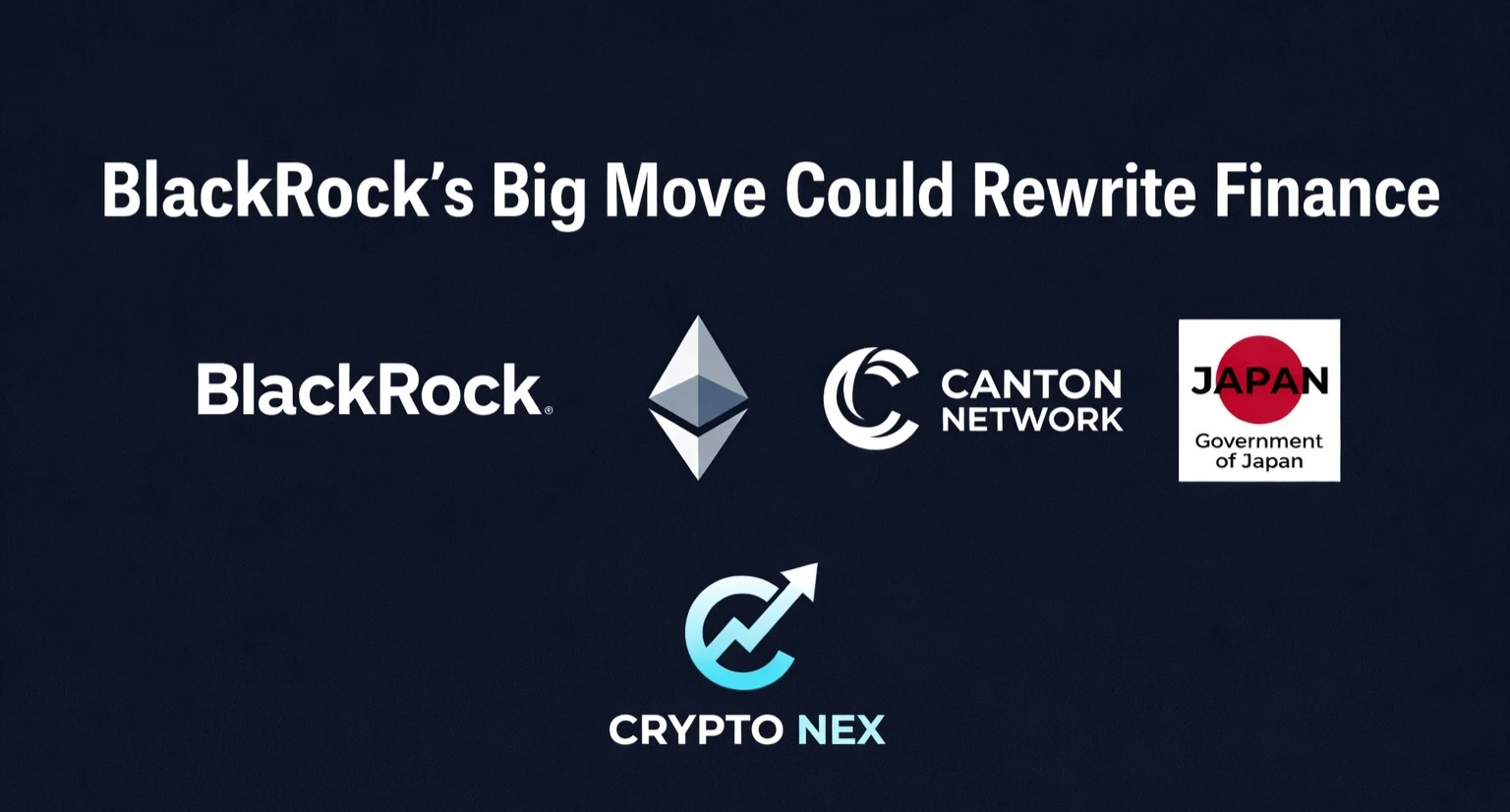
BlackRock, Japan, and the Rise of Tokenized Finance in the Age of AI
The financial system is moving into a new phase where tokenization is no longer just a crypto concept. It is becoming part of the discussion among large asset managers, market infrastructure providers, and regulators. Recent moves by BlackRock, institutional experiments in Japan, and renewed debate in Washington all point in the same direction: finance is becoming more programmable, more digital, and more closely tied to blockchain rails.
What makes this moment important is not only the technology itself, but the type of institutions now involved. In earlier cycles, tokenization was often discussed mainly in the context of speculation, trading, or retail adoption. Today, the conversation includes money-market funds, sovereign collateral, government bonds, and market structure rules. That is a much more serious stage of development.
Why this moment matters
BlackRock’s latest move is one of the clearest examples. The firm is preparing tokenized money-market products on Ethereum tied to a Treasury-based liquidity fund reportedly worth about $6.1 billion. The significance is not just that blockchain is involved. It is that the product is reportedly aimed at investors already holding meaningful capital in stablecoins, which suggests that digital-dollar liquidity is starting to influence mainstream financial product design.
This matters because stablecoins are no longer just a trader’s parking tool. They now sit at the center of many crypto workflows, including transfers, liquidity management, settlement preparation, and treasury allocation. If a major asset manager is designing products around that pool of capital, the market has to take the signal seriously.
Japan’s institutional blockchain trial
Japan is moving in a related direction through a proof-of-concept involving Mizuho Financial Group, Nomura Holdings, Japan Securities Clearing Corporation, and Digital Asset. The trial explores blockchain-based collateral management using Japanese government bonds on the Canton Network, making it a test of core institutional market plumbing rather than a retail crypto experiment.
That distinction is important. Japanese government bonds are central to one of the world’s largest sovereign debt systems, so a pilot involving JGB collateral touches real questions about settlement, liquidity flow, collateral mobility, and operational efficiency. Even as a proof of concept, it signals that tokenization is being evaluated at a much deeper layer of finance.
The Japanese trial also highlights a key point often missed in crypto debates: some of the most important blockchain adoption may happen in permissioned, institution-first environments. In these settings, privacy, compliance, and controlled interoperability matter more than open retail participation. That means blockchain adoption will likely be multi-layered, not limited to public-chain speculation.
Washington and market structure
At the same time, Washington is once again working on the legal side of the story. The Senate Banking Committee has scheduled a markup for the CLARITY Act on May 14, 2026, in another sign that US lawmakers are still trying to push digital assets toward a clearer market structure framework.
That regulatory layer matters because institutional adoption depends on legal certainty almost as much as technology. For years, firms in the crypto sector have operated under unclear jurisdictional boundaries and uneven enforcement expectations. If lawmakers make measurable progress on market structure, it could reduce one of the biggest barriers holding back wider institutional participation.
The important point is that infrastructure and regulation are moving together. Institutions are building before every rule is finalized, but policymakers are also under pressure to respond as blockchain-based financial products become harder to ignore. That dynamic is one of the reasons this cycle feels structurally different from earlier ones.
Why AI fits the thesis
The broader story becomes even more interesting when AI enters the picture. Some investors and founders argue that tokenization is not just about assets, but about making value and information machine-readable, verifiable, and easier for autonomous systems to use. In that view, tokenization becomes part of the operating layer for an economy in which AI agents can eventually transact, allocate resources, and interact with financial infrastructure directly.
The idea sounds ambitious, but the basic logic is simple. If machines are going to participate more deeply in economic activity, they need systems that are structured and easy to process. Tokenized assets, programmable settlement, and machine-readable claims fit that need better than fragmented legacy systems built around manual reconciliation and isolated databases.
This is one reason the current shift feels bigger than a normal crypto narrative. The market is not only talking about price action or user adoption. It is talking about infrastructure that can support settlement, liquidity, compliance, and automation at scale. That is a far larger and more durable conversation.
What the market is really seeing
For years, critics argued that blockchain had limited real-world utility beyond speculation. That argument is becoming harder to defend as more serious financial products and market-infrastructure trials begin using tokenization or blockchain-style systems. Money-market products, collateral management, sovereign debt workflows, and regulatory design all point to a more mature phase of adoption.
This does not mean every project will succeed, and it does not mean every tokenized product will find immediate demand. But it does mean the direction of travel is becoming clearer. Institutions are increasingly willing to test tokenization when it solves a practical problem tied to liquidity, settlement, compliance, or product structure.
Another useful way to frame the shift is through coordination. Financial markets are not only venues for trading; they are systems for organizing, pricing, moving, and settling value. Tokenization matters because it can reduce friction inside that coordination layer, which is where many of the real economic gains may emerge over time.
What to watch next
In the near term, three things matter most. First, whether BlackRock’s tokenized money-market initiative expands and attracts stablecoin-based capital. Second, whether Japan’s blockchain collateral experiments evolve into broader institutional frameworks. Third, whether the United States moves closer to a more coherent market-structure regime through the CLARITY Act or related policy steps.
These three layers matter because they map directly to the architecture of a new financial model: product design, market infrastructure, and regulation. When all three begin moving in the same direction, the shift stops looking like isolated news and starts looking like systemic change.
The deepest takeaway is straightforward. Tokenization is becoming part of the mainstream financial conversation. It is no longer just about speculative crypto cycles. It is increasingly about how money, collateral, assets, and data will move in a more digital, more automated, and eventually more AI-connected financial environment.
That is why the developments around BlackRock, Japan, and Washington matter. They do not guarantee a smooth or immediate transformation, but they do show that the next financial system is being built in layers right now. The infrastructure is being tested. The rules are being debated. The capital is watching. And the next phase of crypto may be defined less by hype than by how successfully these new rails are adopted.
Editorial references
- Bloomberg — BlackRock Readies Launch of Two Tokenized Money-Market Funds
- Japan Exchange Group / JSCC — Launch of proof-of-concept trial for digital collateral management using Japanese Government Bonds
- KuCoin News — Senate Banking Committee Schedules May 14 Markup for CLARITY Act
- Crypto Briefing — US Senate Committee to consider Clarity Act crypto bill
- Structured Retail Products — Japanese institutions launch JGB digital collateral proof of concept
- Japan Just Put Its $9T Bond Market On-chain
- Blackrock to Launch Tokenized Money-Market Funds on Ethereum
- Best practices for article pages
- Elevating original reporting in Search
Key topics: BlackRock, Japan, tokenization, Ethereum, stablecoins, money-market funds, Canton Network, Japanese government bonds, JSCC, Mizuho, Nomura, Digital Asset, CLARITY Act, crypto regulation, institutional finance, AI agents.
Disclaimer: This article is for informational purposes only and does not constitute financial, investment, or legal advice.
