

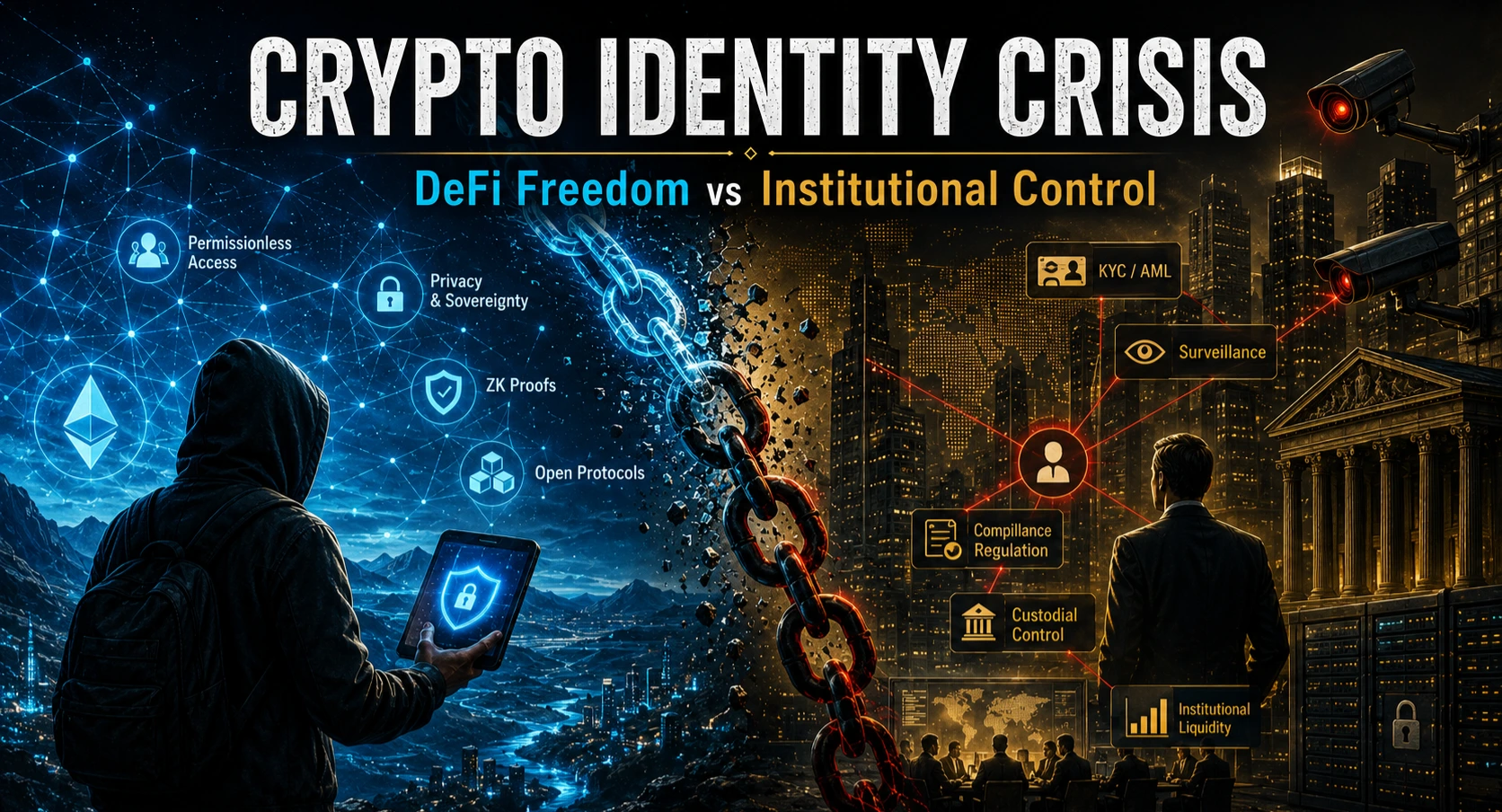
For over a decade, the core ethos of decentralized digital assets operated on a foundational promise: the complete uncoupling of personal wealth from centralized oversight. While the early architecture relied on the raw, unadulterated execution of code, the current structural transitions sweeping through the crypto ecosystem reveal a profound paradigm shift—one that is subtly altering the very genetic makeup of global liquidity networks.
We are currently witnessing an unprecedented institutional enclosure of the digital asset space. This transition is not merely defined by the historic capital inflows into spot index products or the gradual professionalization of market makers; it represents a systematic re-engineering of the financial ecosystem. The global gatekeepers of traditional finance (TradFi) are no longer ignoring the decentralized matrix—they are actively swallowing its infrastructure.
This macro reorganization presents a deep philosophical paradox. Under the banner of "global adoption" and regulatory legitimacy, institutional architects are offering retail participants a highly sanitized, easily accessible version of crypto. Yet, this systematic corporate framing is designed to ingest decentralized capital while gradually eroding the investor's ultimate leverage: on-chain privacy, censorship resistance, and absolute capital sovereignty.
1. The Regulatory Enclosure: How Decentralized Rails Are Being Confined
To fully deconstruct the prevailing mainstream financial narratives, one must analyze how regulatory and state-backed frameworks are systematically modifying their compliance apparatus to restrict peer-to-peer execution. This subtle structural tightening is currently materializing across three critical operational layers:
- The Mandatory Identification Gateways: Global regulatory frameworks, spearheaded by legislative updates like the CLARITY Act, are aggressively expanding Know-Your-Customer (KYC) requirements to non-custodial smart contracts. By targeting open-source developers and frontend user interfaces, authorities are forcing once-permissionless networks to act as centralized compliance filters.
- The Sanitized Liquidity Isolation: Major institutional market makers are systematically routing their capital through isolated, permissioned liquidity pools. This process artificially splits the blockchain into two distinct realities: a premium, highly compliant "institutional layer" and a heavily restricted, deeply scrutinized "retail secondary pool."
- The Relentless Pressure on Self-Custody: Central banking syndicates and financial intelligence units are continuously introducing frameworks aimed at restricting direct transactions between institutional platforms and private, self-hosted smart contracts, seeking to trap the majority of free-floating capital within corporate-managed custodial structures.
2. Structural Mechanics: Permissionless Freedom vs. Corporate Sanitization
Many generalized media outlets mistake the ongoing institutional integration as a unilateral victory for early adopters. However, the operational and structural divergence between true decentralized financial autonomy and the newly engineered corporate-managed ecosystem is stark:
| Core Dynamic | The Pure Decentralized Model (DeFi) | The Sanitized Institutional Layer |
|---|---|---|
| Network Access | Completely open-source, blind execution of code via cryptographic wallets without centralized approval. | Whitelisted wallet registries, mandatory digital identity verification, and sovereign-backed compliance rails. |
| Capital Flows | Fluid, global peer-to-peer liquidity distributions driven entirely by market incentives and automated logic. | Highly centralized routing through corporate custodians (BlackRock, Fidelity) and banking infrastructure. |
| Privacy Framework | Pseudonymous on-chain execution with a strategic emphasis on individual data sovereignty and encryption. | Universal, highly synchronized transaction tracking, transparent AML auditing, and mandatory wallet profiling. |
| Systemic Risk | Smart contract vulnerabilities, localized economic design flaws, and temporary protocol exploits. | Universal macroeconomic market contagion, systemic corporate point-of-failure, and sweeping arbitrary state asset freezes. |
3. Macro Implications: The Invisible Rearrangement of Digital Capital Stacks
These engineered regulatory dynamics do not operate in a vacuum. They generate powerful ripples that gradually reshape the global financial architecture while altering the internal mechanics of decentralized capital:
A. The Ingestion of Yield Mechanics by Corporate Capital
In a truly decentralized environment, protocol yields and network rewards flow directly to the risk-bearing on-chain participants. However, as trillion-dollar asset management funds integrate staking and validation mechanics into their underlying custody products, they absorb the primary economic yield layers, leaving retail market participants to navigate highly diluted, secondary synthetic alternatives.
B. The Dilution of Sovereign Free-Floating Liquidity
By heavily incentivizing institutional exchange-traded fund products (ETFs), the market architecture has intentionally directed massive pools of liquid capital away from native on-chain environments. This massive capital absorption leaves localized on-chain decentralized exchanges (DEXs) highly vulnerable, starved of the organic free-floating liquidity needed to defend long-term price floors during broader macroeconomic systemic collapses.
C. The Rise of Privacy-Enhancing Cryptographic Cryptography
As corporate entities and sovereign regulatory bodies scale up their transaction-tracking networks, human development groups are experiencing an intense operational reaction. This has ignited a massive, synchronized push toward advanced cryptographic layers—such as Zero-Knowledge (ZK) infrastructure and encrypted state execution networks—as developers scramble to preserve basic data privacy before corporate surveillance networks complete their on-chain integration.
4. The Sociological Cycle: Deconstructing the "Legitimization" Narrative
Stepping past purely financial data points reveals a recurring historical human phenomenon that consistently unfolds whenever decentralized movements scale up significantly:
The Mechanics of Institutional Absorption: When traditional financial syndicates invest massive political and regulatory resources to build compliant on-ramps for alternative asset classes, it is rarely a sign of philosophical conversion. Historically, this pattern represents institutional absorption—a process where status-quo insiders capture a disruptive, parallel economic system and bend its rules to protect and extend their own legacy financial dominance.
Historical Echoes: This macro playbook directly mirrors the psychological structural setups observed during the early normalization of global commodities and the institutionalization of independent equity clearinghouses. In both instances, intense promises of "market stability and safety" masked the systemic extraction of individual sovereignty, leaving retail collectives operating within a heavily managed environment while true systemic control evaporated from their hands.
The Strategic Horizon: Navigating the New Cryptographic Reality
The intense, ongoing structural shift within the digital asset network is not a momentary phase meant for temporary trader distraction. It is a stark reminder of the immutable laws governing centralized power structures. In this complex financial evolution, decentralized networks are slowly moving out of their isolated sandbox and transforming into highly coordinated environments heavily managed by institutional gravity.
Your responsibility as an independent market participant must naturally adjust. You must transition from an emotional spectator—captivated by corporate media hype and institutional narratives—into an analytical on-chain architect. Independent market operators must carefully evaluate protocol incentives, scrutinize underlying smart contract code, and insulate their private portfolios from centralized exit-door traps.
The traditional banking machinery commands the primary compliance rails, dictates the regulatory timelines, and controls the dominant custodial vaults; but you retain absolute, definitive control over your cryptographic keys. True economic resilience lies not in waiting for corporate approval, but in fiercely preserving your digital sovereignty for clear, unadulterated financial independence.
💡 Join the Discussion:
As institutional cartels re-engineer the compliance matrix to absorb the decentralized capital stack, what is your immediate strategic defensive playbook? Are you transitioning your portfolio into highly isolated privacy-preserving protocols, or are you utilizing corporate custodial products for short-term macroeconomic gains? Let us know your thoughts in the comments below!
