

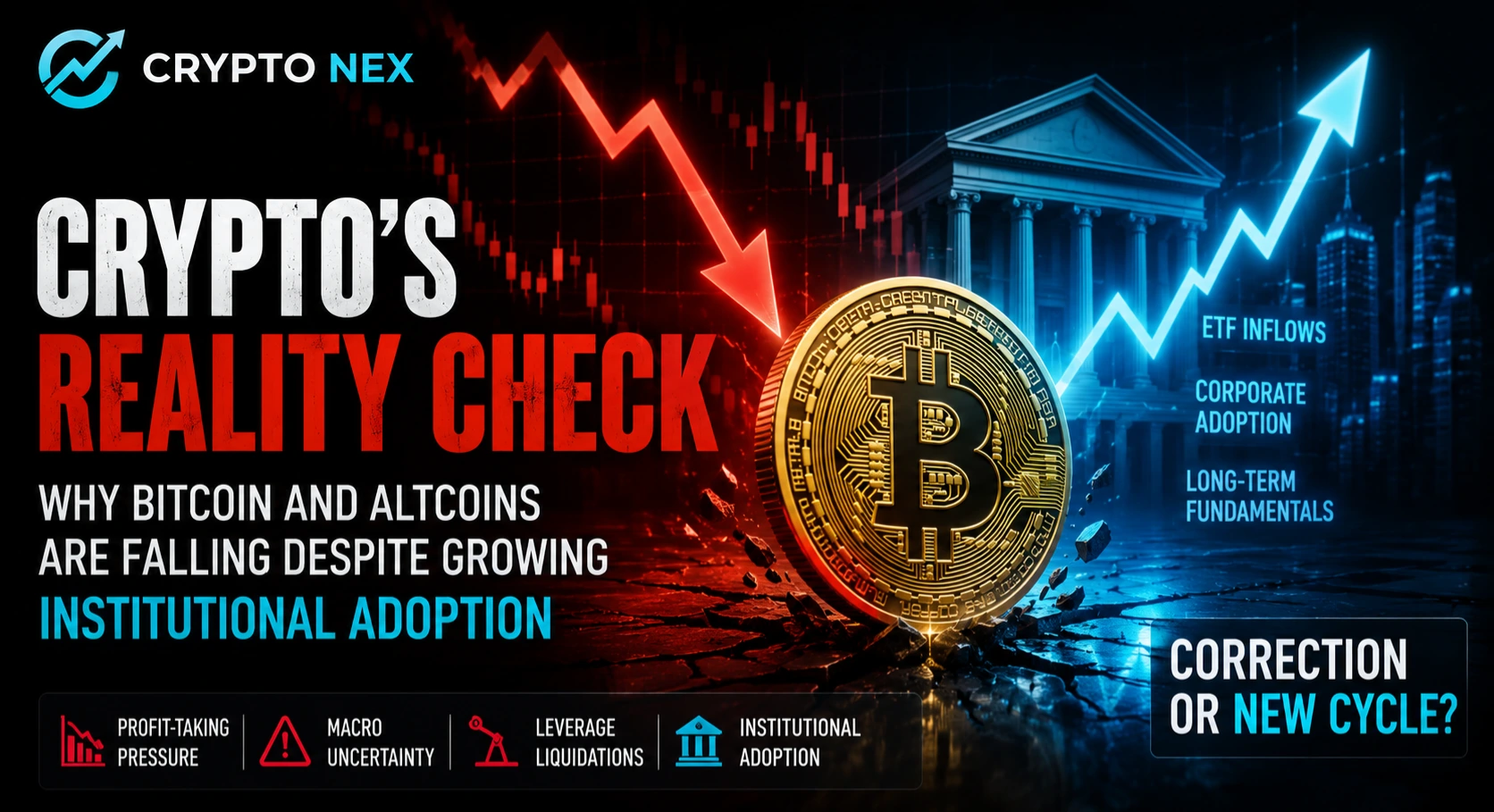
Crypto’s Reality Check: Why Bitcoin and Altcoins Are Falling Despite Growing Institutional Adoption
The cryptocurrency market has entered one of its most confusing phases in recent years. On one hand, institutional participation continues to grow, Bitcoin exchange-traded funds have attracted billions of dollars, and major corporations remain committed to digital assets. On the other hand, Bitcoin and many leading cryptocurrencies have suffered sharp declines, leaving investors wondering why prices are falling while adoption appears stronger than ever.
This apparent contradiction highlights an important truth about financial markets: adoption and price do not always move in the same direction over short periods. While long-term fundamentals may improve, markets can still experience powerful corrections driven by liquidity conditions, investor sentiment, macroeconomic uncertainty, and profit-taking.
The latest decline is forcing investors to ask difficult questions. Is this merely a healthy correction within a larger bull cycle, or is the market entering a deeper phase of repricing? More importantly, what factors are actually driving the current selloff?
Institutional Adoption Is Not a Straight Line Up
One of the biggest misconceptions among retail investors is the belief that institutional adoption automatically guarantees higher prices. The reality is far more complex.
Over the past two years, institutions have become increasingly involved in digital assets. Spot Bitcoin ETFs have created new investment channels, traditional asset managers have expanded their crypto offerings, and publicly traded companies continue to hold Bitcoin on their balance sheets.
However, institutional investors are not emotional buyers. Unlike retail traders chasing momentum, institutions manage risk carefully and frequently rebalance portfolios. This means periods of strong buying can be followed by periods of reduced exposure, profit-taking, or capital rotation into other sectors.
As a result, institutional participation often increases market maturity rather than eliminating volatility.
Profit-Taking After Massive Gains
Another major factor behind the recent weakness is simple profit-taking.
Bitcoin experienced a powerful rally that pushed prices to historic levels. Many early investors, hedge funds, and large holders accumulated significant unrealized gains during the move.
Financial markets rarely move in a straight line. When large profits accumulate, some investors naturally decide to lock in gains. These sales create additional supply and can trigger broader market corrections, especially when leverage is elevated.
The current decline appears to reflect this reality. After months of optimism, investors are reassessing risk and taking profits, creating temporary downward pressure across the market.
Macroeconomic Conditions Are Still Dominating Markets
Crypto markets do not exist in isolation.
Interest rate expectations, inflation data, labor market reports, and central bank policies continue to influence investor behavior. When uncertainty increases across traditional financial markets, risk assets often face pressure.
Many investors expected central banks to move more aggressively toward monetary easing. However, persistent inflation concerns and economic uncertainty have complicated that outlook.
As a result, some capital has moved away from speculative assets and toward investments perceived as offering more predictable returns.
This dynamic has affected not only cryptocurrencies but also segments of the technology and growth-stock sectors.
The Leverage Problem Returns
Leverage remains one of the most important drivers of short-term crypto volatility.
During periods of optimism, traders frequently increase exposure using borrowed capital. While leverage can amplify gains, it also magnifies losses when prices move against market participants.
As Bitcoin began to decline, large numbers of leveraged positions were liquidated across derivatives exchanges. These forced liquidations accelerated selling pressure and intensified market weakness.
This cycle has appeared repeatedly throughout crypto history. Excessive leverage creates fragile market conditions where even modest declines can trigger cascading liquidations.
The result is often a sharp but temporary selloff that exceeds what fundamentals alone would justify.
Capital Rotation Toward Other Opportunities
Another factor receiving less attention is capital rotation.
Global investors constantly search for the highest risk-adjusted returns. When new opportunities emerge in artificial intelligence, technology equities, or other high-growth sectors, some capital naturally shifts away from crypto markets.
This does not necessarily indicate a loss of confidence in digital assets. Instead, it reflects the reality that investors operate within a broader financial ecosystem.
Money moves where opportunities appear most attractive at a given moment.
The crypto market is increasingly integrated into global capital markets, making these rotations more visible than in previous cycles.
Why Altcoins Are Suffering Even More
While Bitcoin has experienced significant pressure, many altcoins have performed even worse.
This pattern is common during periods of uncertainty. Investors often reduce exposure to higher-risk assets first, concentrating capital in larger and more established cryptocurrencies.
Projects with weaker fundamentals, lower liquidity, or limited real-world adoption tend to experience the steepest declines.
This process effectively acts as a market filter, separating speculative narratives from projects capable of generating sustainable value.
Historically, periods like this have accelerated the maturation of the broader ecosystem by forcing investors to focus on fundamentals rather than hype.
The Difference Between Sentiment and Fundamentals
One of the most important lessons from the current correction is that sentiment and fundamentals are not the same thing.
Market sentiment can change rapidly. A single disappointing economic report or a wave of liquidations can trigger widespread fear.
Fundamentals, however, evolve much more slowly.
Institutional infrastructure continues to expand. Blockchain development remains active. Regulatory frameworks are becoming clearer in several major jurisdictions. Tokenization initiatives continue to attract attention from financial institutions worldwide.
These developments suggest that the long-term story of digital assets remains intact, even as short-term volatility dominates headlines.
What Investors Should Watch Next
- Institutional ETF inflows and outflows.
- Federal Reserve policy and interest-rate expectations.
- Liquidity conditions across global markets.
- Bitcoin's ability to maintain key support levels.
- The pace of blockchain adoption by financial institutions.
- Regulatory developments in the United States, Europe, and Asia.
Conclusion
The recent decline in Bitcoin and the broader cryptocurrency market does not necessarily contradict the growing trend of institutional adoption. Instead, it highlights the complexity of modern financial markets.
Profit-taking, macroeconomic uncertainty, leverage-driven liquidations, and capital rotation are all contributing to current market weakness. While these forces have created significant short-term pressure, they do not automatically invalidate the long-term growth story surrounding digital assets.
The market is experiencing a reality check rather than a fundamental collapse. Investors are being reminded that even in an era of ETFs, institutional participation, and expanding blockchain infrastructure, volatility remains an essential part of the crypto landscape.
The coming months will reveal whether this correction becomes a launchpad for the next phase of growth or a signal that the market requires more time to consolidate before moving higher.
Editorial References
- Bitcoin ETF Market Developments
- Institutional Crypto Adoption Trends
- Federal Reserve Monetary Policy Updates
- Global Crypto Market Liquidity Reports
- Blockchain Infrastructure Research
- Digital Asset Regulatory Developments
Key Topics: Bitcoin, Ethereum, Crypto Market, Institutional Adoption, ETFs, Federal Reserve, Market Correction, Digital Assets, Blockchain Infrastructure, Altcoins.
Disclaimer: This article is for informational purposes only and does not constitute financial, investment, or legal advice. Investors should conduct their own research before making investment decisions.
